

Note
Go to the end to download the full example code.
Explaining Seldon Predictions with Shapley Values
Neuralk’s SeldonClassifier and SeldonRegressor are black-box
foundation models, but you can still understand why they make a given
prediction. The neuralk.explainability module wraps the shapiq package to provide:
local explanations — how each feature (and feature interaction) contributed to a single prediction, and
global explanations — overall feature importance aggregated across many predictions.
Note
Explanations require the optional dependency, installed with
pip install "neuralk[explain]". It targets Python 3.12+.
For this example to run, the environment variable API_KEY must be set
with your Neuralk API key.
Warning
Seldon predicts through remote API calls that consume credits. Explainers
evaluate the model on many perturbed inputs, so keep the background set
small and the estimation budget modest — as we do below.
Fit a classifier
We use a small, synthetic dataset where only the first two features carry signal, so the explanations have a clear ground truth to recover.
import os

from sklearn.datasets import make_classification
from sklearn.model_selection import train_test_split

from neuralk import SeldonClassifier
from neuralk.explainability import SeldonExplainer

X, y = make_classification(
    n_samples=80,
    n_features=5,
    n_informative=2,
    n_redundant=0,
    random_state=0,
)
feature_names = [f"feature_{i}" for i in range(X.shape[1])]

X_train, X_test, y_train, y_test = train_test_split(
    X, y, test_size=0.25, random_state=0
)

# Assigned, not left as the cell's last expression: the gallery would render
# the estimator there, API key included.
clf = SeldonClassifier(api_key=os.environ.get("API_KEY")).fit(X_train, y_train)
Build an explainer
SeldonExplainer wraps the fitted classifier.
The background data is used to fill in “absent” features while estimating
Shapley values; a subset of the training data works well. We request
max_order=2 so pairwise feature interactions are estimated too.
explainer = SeldonExplainer(
    clf,
    background=X_train,
    feature_names=feature_names,
    index="k-SII",
    max_order=2,
    max_background_samples=40,
    random_state=0,
)
Local explanation
Explain a single prediction. budget controls how many model evaluations
shapiq may use — higher is more accurate but slower (and costs more credits).
/home/runner/work/neuralk/neuralk/.venv/lib/python3.12/site-packages/shapiq/approximator/regression/base.py:168: UserWarning: Not all budget is required due to the border-trick.
  self._sampler.sample(budget)
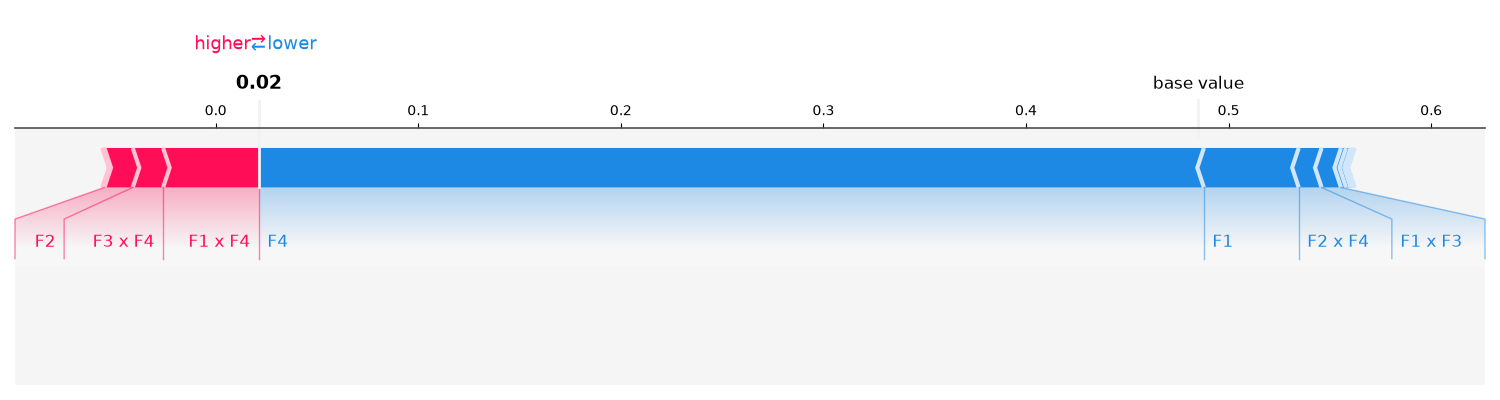
InteractionValues(
    index=k-SII, max_order=2, min_order=0, estimated=False, estimation_budget=128,
    n_players=5, baseline_value=0.4850693643093109,
    Top 10 interactions:
        (): 0.4850693643093109
        (1, 4): 0.04725679230227252
        (3, 4): 0.0149738462320378
        (2,): 0.013976146339672018
        (3,): -0.0022725993758701294
        (1, 2): -0.002481457044983662
        (1, 3): -0.00958788087736256
        (2, 4): -0.011287395375390431
        (1,): -0.04681731855873862
        (4,): -0.46650091549989325
)
Visualize the contribution of each feature with a force plot.
explainer.plot_force(local, show=True)

Global explanation
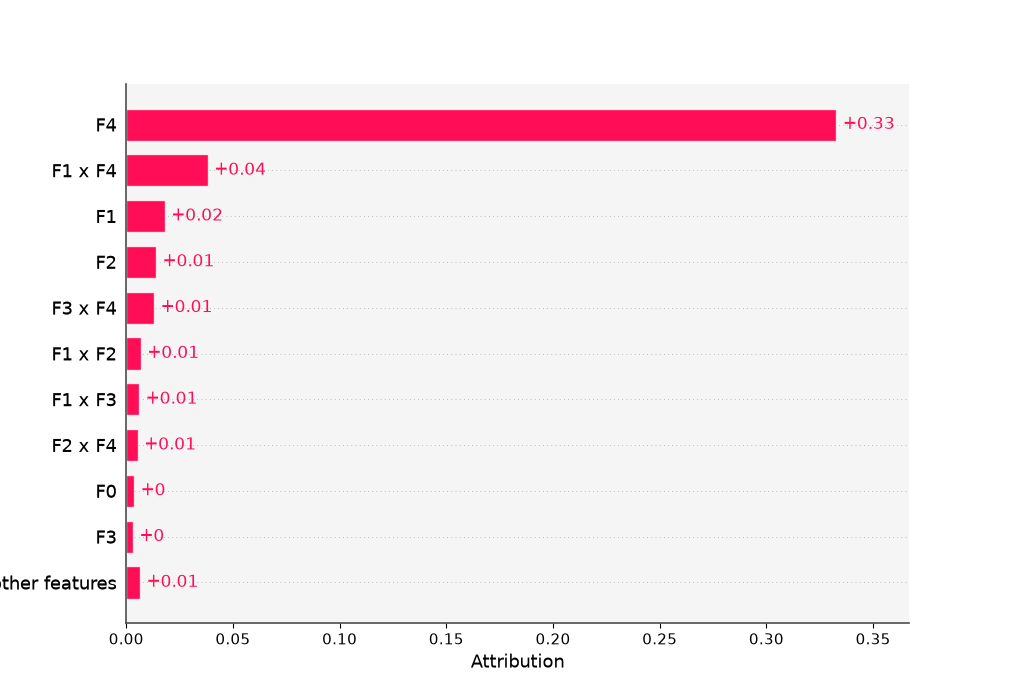
Aggregate explanations over several test instances to see which features
matter on average. explain_global runs one local explanation per instance,
so its cost grows with the number of rows: we explain a modest subset.
global_explanation = explainer.explain_global(X_test[:10], budget=128)
/home/runner/work/neuralk/neuralk/.venv/lib/python3.12/site-packages/shapiq/approximator/regression/base.py:168: UserWarning: Not all budget is required due to the border-trick.
  self._sampler.sample(budget)
/home/runner/work/neuralk/neuralk/.venv/lib/python3.12/site-packages/shapiq/approximator/regression/base.py:168: UserWarning: Not all budget is required due to the border-trick.
  self._sampler.sample(budget)
/home/runner/work/neuralk/neuralk/.venv/lib/python3.12/site-packages/shapiq/approximator/regression/base.py:168: UserWarning: Not all budget is required due to the border-trick.
  self._sampler.sample(budget)
/home/runner/work/neuralk/neuralk/.venv/lib/python3.12/site-packages/shapiq/approximator/regression/base.py:168: UserWarning: Not all budget is required due to the border-trick.
  self._sampler.sample(budget)
/home/runner/work/neuralk/neuralk/.venv/lib/python3.12/site-packages/shapiq/approximator/regression/base.py:168: UserWarning: Not all budget is required due to the border-trick.
  self._sampler.sample(budget)
/home/runner/work/neuralk/neuralk/.venv/lib/python3.12/site-packages/shapiq/approximator/regression/base.py:168: UserWarning: Not all budget is required due to the border-trick.
  self._sampler.sample(budget)
/home/runner/work/neuralk/neuralk/.venv/lib/python3.12/site-packages/shapiq/approximator/regression/base.py:168: UserWarning: Not all budget is required due to the border-trick.
  self._sampler.sample(budget)
/home/runner/work/neuralk/neuralk/.venv/lib/python3.12/site-packages/shapiq/approximator/regression/base.py:168: UserWarning: Not all budget is required due to the border-trick.
  self._sampler.sample(budget)
/home/runner/work/neuralk/neuralk/.venv/lib/python3.12/site-packages/shapiq/approximator/regression/base.py:168: UserWarning: Not all budget is required due to the border-trick.
  self._sampler.sample(budget)
/home/runner/work/neuralk/neuralk/.venv/lib/python3.12/site-packages/shapiq/approximator/regression/base.py:168: UserWarning: Not all budget is required due to the border-trick.
  self._sampler.sample(budget)
Rank features by mean absolute contribution:
importances = global_explanation.feature_importances(normalize=True)
for name, score in importances.items():
    print(f"{name:>12}: {score:.3f}")
feature_4: 0.896
feature_1: 0.048
feature_2: 0.037
feature_0: 0.010
feature_3: 0.008
And the corresponding aggregated bar plot:
global_explanation.plot_bar(show=True)
Total running time of the script: (0 minutes 22.986 seconds)